
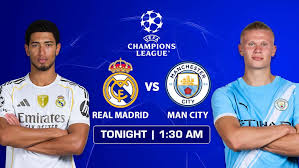
In the grand, sprawling narrative of European football, certain fixtures emerge that transcend the ordinary. They become more than just a game; they are cultural events, tactical chess matches, and collisions of history against ambition. No encounter embodies this dichotomy in the modern era quite like Real Madrid versus Manchester City. This is not merely a battle between two football clubs. It is a clash of epochs—the established, dynasty-built royalism of Madrid against the innovative, resource-rich project of City. When these two leviathans meet on the pitch, it feels like a final before the final, a contest that often decides the very direction of the UEFA Champions League. The phrase Real Madrid vs Man City has become synonymous with peak continental drama, a fixture where legends are cemented, and dreams are both realized and shattered in the space of ninety minutes. This rivalry, though young in comparison to football’s ancient grudges, has rapidly intensified to become the defining narrative of 21st-century club football’s elite tier.
The essence of this showdown lies in its beautiful contrast. Real Madrid, the club with La Decima woven into its white fabric, operates with a psychological aura of inevitability in this competition. Their history is not just background noise; it is an active participant, a weight on the shoulders of opponents. Manchester City, under the meticulous guidance of Pep Guardiola, represents the cutting edge of tactical science and sustained domestic dominance seeking its ultimate validation in Europe. Every meeting is a study in this tension: tradition versus innovation, cold passion versus calculated genius, the relentless spirit of comeback against the desire for flawless control. The narrative is rich, layered, and constantly evolving, making each chapter of the Real Madrid vs Man City saga a must-watch spectacle that captivates the global footballing audience.
A visual representation of the intense physical and tactical battle that defines this fixture.
The Historical Context and Evolution of a Rivalry
To understand the gravity of Real Madrid vs Man City, one must look at the divergent paths that led them to this point of constant collision. Real Madrid’s relationship with the European Cup is foundational. They are the competition’s most successful club, its original protagonist, with a record fourteen titles that speaks to a century of prioritizing continental glory. Their identity is built on galáctico signings, dramatic nights at the Santiago Bernabéu, and an almost mythical belief that they own this tournament. For decades, their rivals in this space came from a familiar set: AC Milan, Bayern Munich, Liverpool, and their eternal Spanish clash with Barcelona. Manchester City, until the last decade and a half, was not part of this conversation.
Manchester City’s journey to this elite table is a story of transformative investment and visionary project-building. Following the 2008 takeover, the club embarked on a long-term plan to dominate English football and conquer Europe. This project found its philosophical core in the appointment of Pep Guardiola in 2016. Guardiola instilled a distinct, possession-dominant, tactically fluid style of play that began to steamroll the Premier League. However, the Champions League remained the elusive final piece. Their ascent meant that a clash with the competition’s standard-bearer was inevitable. The early meetings were learning experiences for City, often edged by Madrid’s knockout experience. But with each passing season, the balance of power began to subtly shift, turning a one-sided historical narrative into a genuine, fierce, and unpredictable rivalry. The fixture Real Madrid vs Man City is now a pivot point in the Champions League draw, a match that analysts and fans circle immediately, knowing it could be the de facto final.
This evolution is not just about results; it’s about a shift in perception. City, once the ambitious newcomer, now steps onto the pitch with the confidence of a footballing superpower. Real Madrid, while respecting their own history, now sees City not as an upstart but as perhaps their most formidable contemporary opponent. The rivalry gained its emotional and narrative depth from iconic moments: Sergio Ramos’ last-gasp equalizer in 2016, Pep Guardiola’s tactical overthink in 2022, and the sheer madness of the 4-3 and 3-1 encounters. These games have written their own history in a short time, creating a shared, intense past that fuels every new meeting. The context is no longer just about City chasing Madrid’s legacy; it’s about two giants at the peak of their powers, each trying to impose their era’s definition of footballing excellence on the other.
Tactical Philosophies: The Art of Control vs. The Spirit of Chaos
At the heart of every Real Madrid vs Man City encounter is a fascinating clash of footballing ideologies. While both teams boast squads filled with world-class individuals, their approaches to winning are philosophically distinct, setting the stage for a compelling tactical duel every time they meet.
Manchester City, under Pep Guardiola, is the modern blueprint for controlled, systematic football. Their game is built on the foundation of possession, not just for keeping the ball, but as a weapon to suffocate the opponent. The principle is territorial dominance. Guardiola’s City seeks to control every variable: they press high to win the ball back in dangerous areas, they use their goalkeeper as an extra outfielder to bypass presses, and their movement off the ball is orchestrated to create passing lanes and destabilize defensive structures. The aim is to reduce the game to a pattern where the opponent is merely reacting, chasing shadows, and eventually making a fatal mistake. Players like Rodri and Kevin De Bruyne are the conductors of this orchestra, metronomically dictating the tempo and direction of play. When facing City, teams often speak of the physical and mental fatigue induced by their relentless, precise style.
“Playing against Manchester City is the most demanding game in world football. You have to be perfect in your concentration and decisions for 95 minutes, or they will punish you.” – A prominent European manager.
In stark contrast, Real Madrid, particularly in the latter stages of the Champions League, embraces a different kind of power: the power of chaos, emotion, and individual brilliance. Under Carlo Ancelotti, their structure is more adaptable, often ceding possession and territorial advantage to opponents. Ancelotti’s genius in Europe lies in his team’s strategic patience and devastating transitions. They are happy to absorb pressure, defend in a compact mid-block, and then explode forward with breathtaking speed and precision when the ball is turned over. This approach leverages the space left behind attacking teams, which plays directly into the strengths of players like Vinícius Júnior, Rodrygo, and Jude Bellingham. Madrid’s tactic is not about controlling the 90 minutes; it’s about controlling the key moments—the moments of truth. They possess an almost supernatural belief that they can score at any time, from any situation, which makes them uniquely dangerous even when they are being outplayed. This makes the Real Madrid vs Man City tactical battle a classic case of the irresistible force meeting the immovable object, or more accurately, the perfect system meeting the indomitable spirit.
| Tactic | Manchester City’s Approach | Real Madrid’s Approach |
|---|---|---|
| Possession | Highest priority. Used to control the game and tire the opponent. | A tool, not a religion. Willingly sacrificed for defensive solidity and counter-attacks. |
| Defensive Shape | High press to win the ball back immediately. Aggressive and coordinated. | Organized mid-to-low block. Focus on shape, discipline, and forcing errors in dangerous areas. |
| Attack Focus | Constructive buildup, creating overloads, and intricate passing patterns in final third. | Rapid vertical transitions, exploiting space behind with pace, and relying on individual genius. |
| Key Mentality | Domination through systemic execution. | Resilience and supremacy in decisive moments. |
Key Battles on the Pitch: Where Games Are Won and Lost
When the tactical plans are implemented, the Real Madrid vs Man City fixture boils down to a series of electrifying individual duels across the pitch. These personal battles often dictate the flow and ultimately the outcome of the match, pitting some of the world’s best players against each other in high-stakes scenarios.
One of the most critical contests takes place in the center of the park, often between City’s Rodri and Madrid’s Jude Bellingham or Toni Kroos. Rodri is City’s lighthouse, the single pivot who breaks lines with his passing and provides essential defensive cover. His duel with Bellingham, who ghosts into the box from midfield, or with Kroos, who dictates tempo with his peerless range of passing, is a battle for the soul of the game. If Rodri is allowed to control the game’s rhythm, City dominates. If Bellingham can break beyond him or Kroos can bypass him with long passes, Madrid finds its route to goal. This central corridor is where the philosophical clash becomes physical.
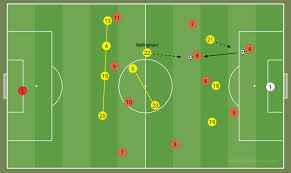
The midfield battle, often between players like Rodri and Bellingham, sets the tactical tone for the entire match.
Another defining duel is on the flank, where Manchester City’s right-back, whether Kyle Walker or another, faces the blistering pace and trickery of Real Madrid’s Vinícius Júnior. This is arguably the most direct and explosive matchup on the pitch. Walker’s recovery pace has historically been one of the few tools capable of matching Vinícius, turning this into a captivating athletic contest. However, Vinícius’s improved decision-making and final ball make him a constant threat, requiring not just physicality but immense defensive intelligence from his marker. The outcome of this wing battle can single-handedly unlock a defense or nullify a team’s primary attacking outlet.
Furthermore, the strategic mind games between the two managers, Pep Guardiola and Carlo Ancelotti, are a battle in themselves. Guardiola is known for his meticulous, sometimes surprising, tactical tweaks for big games—adjusting his formation, player roles, or pressing triggers. Ancelotti, the master of man-management and big-game calm, responds with pragmatic adjustments, often trusting his veterans’ experience and his team’s innate mentality. This duel from the technical area adds a layer of intrigue, as each tries to outthink the other, making the Real Madrid vs Man City encounter a chess match played at a hundred miles per hour with the world’s most expensive pieces. These key battles, from the technical area to the touchline, weave together to create the epic tapestry that defines this modern classic.
Iconic Matches and Unforgettable Moments
The Real Madrid vs Man City rivalry, though relatively young, has already produced a treasure trove of iconic matches that are etched into Champions League folklore. These games have served as the accelerant for the rivalry’s intensity, each adding a new layer of drama, heartbreak, and breathtaking football.
The semi-final first leg in 2022 was a masterpiece of chaos and attacking football, ending 4-3 to Manchester City at the Etihad. It was a match that defied tactical analysis for large periods, instead becoming a showcase of individual brilliance and defensive fragility. Kevin De Bruyne and Gabriel Jesus raced City into an early lead, only for Karim Benzema to drag Madrid back into the tie with a clever finish. The second half saw Phil Foden and Bernardo Silva score for City, each time answered by Vinícius Jr. and Benzema again—the Frenchman with an audacious Panenka penalty. This rollercoaster established the tone for the tie: that no lead was safe, and that Madrid’s fighting spirit was a tangible force. It set the stage for one of the most remarkable comebacks in the competition’s history a week later.
The sheer emotion of a pivotal goal captures the high-stakes drama of this rivalry.
The return leg at the Santiago Bernabéu is the stuff of legend. With City leading 5-3 on aggregate deep into the 90th minute, the tie seemed over. What followed was a collapse of City’s resolve and an explosion of Madrid’s mythical European aura. Two quick goals from Rodrygo in the 90th and 91st minutes sent the game to extra time, where a penalty from the ice-cool Benzema completed the unthinkable comeback. This match was more than a result; it was a psychological event. It reinforced the narrative of Madrid’s inevitability and planted a seed of doubt in City’s psyche about their ability to close out the biggest games. It was the definitive chapter that elevated the Real Madrid vs Man City fixture from a high-quality contest to a legendary rivalry. These moments are not just remembered; they are referenced every time the two teams are drawn together, hanging in the air like a specter, influencing the mindset of players and fans alike before a ball is even kicked.
The Star Players: Architects of Destiny
While tactics and history provide the framework, the Real Madrid vs Man City saga is ultimately written by its star players. These are the athletes whose moments of genius, sheer will, and technical excellence decide these finely balanced encounters. They are the architects of their team’s destiny on these colossal nights.
For Manchester City, the creative burden has long fallen on Kevin De Bruyne. The Belgian midfielder is the engine of City’s attack, capable of deciding a game with a single pass or thunderous strike from distance. His vision to spot runs and his execution to deliver the ball are unparalleled, making him the primary weapon to break down organized defenses. Alongside him, the rise of Erling Haaland has added a terrifying new dimension. Haaland is the ultimate penalty-box predator, a physical phenomenon whose sheer presence occupies multiple defenders and whose finishing is ruthlessly efficient. His duel with Madrid’s center-backs, often Antonio Rüdiger, is a physical battle of monumental proportions. Then there is Rodri, the silent conductor, whose importance is often most keenly felt in his absence. His ability to control the tempo, shield the defense, and contribute crucial goals makes him the irreplaceable heartbeat of Guardiola’s system.
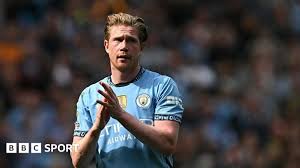
Kevin De Bruyne’s creativity is Manchester City’s key to unlocking stubborn defenses.
Real Madrid’s modern identity in this rivalry has been shaped by a different but equally potent set of stars. For years, Karim Benzema was the protagonist, the clinical finisher and deep-lying playmaker whose intelligence defined their attack. His legacy in this fixture is immense. Now, the mantle has passed to the electrifying Vinícius Júnior. The Brazilian winger is Madrid’s chief danger man, a player whose acceleration, dribbling, and improving end product make him a nightmare for any right-back. He personifies Madrid’s threat on the counter. Alongside him, the arrival of Jude Bellingham has added a new kind of superstar—a box-to-box force with an uncanny knack for arriving in the penalty area at the perfect time. His leadership, physicality, and goal threat have transformed Madrid’s midfield. And of course, the experience of Toni Kroos and Luka Modrić, masters of controlling the game’s rhythm in the tightest of spaces, provides the calming foundation upon which the younger stars can express themselves. In the Real Madrid vs Man City clashes, it is often which set of stars shines brightest in the key moments that tells the final story.
The Stadia: Etihad’s Symphony vs. Bernabéu’s Crucible
The atmosphere in which the Real Madrid vs Man City drama unfolds plays a non-trivial role. Each stadium embodies its club’s character, providing a distinct backdrop that influences the spectacle. The Etihad Stadium and the Santiago Bernabéu are not just venues; they are active participants in the narrative.
The Etihad, particularly on a European night, has transformed into a cauldron of noise and expectation. Manchester City’s fans, once yearning for such nights, now fully embrace their status at the top of the game. The stadium rocks with coordinated chants and a wall of sound, especially during their trademark spell of dominant possession. It is an arena that celebrates the beautiful, systematic football their team plays—a symphony of support for a symphony of play. For visiting teams, it can be an intimidating, overwhelming environment where mistakes are punished not just by the opposition but by the roar of over 50,000 fans. The pitch itself is often kept in immaculate condition, facilitating City’s precise, passing style. Playing at the Etihad means facing a team perfectly synchronized with its surroundings, a challenge that has broken many European contenders.
Conversely, the Santiago Bernabéu is something else entirely. It is not just a stadium; it is a shrine, a museum, and a crucible all in one. For a Real Madrid vs Man City clash, the atmosphere is charged with a different kind of electricity—one steeped in history and entitlement to victory. The famous *“¡Hala Madrid!” echoes with the weight of thirteen previous European crowns. The Bernabéu crowd can be demanding, but in the biggest moments, they become a visceral, united force that seems to suck the ball into the opponent’s net. There is a palpable belief that permeates the stands, a collective will that has spurred countless comebacks. Visiting players speak of the unique pressure of playing there, of the sensation that the stadium itself is against them. For Manchester City, conquering the Bernabéu has been the final step in their Champions League education—a test of not just skill, but of nerve and psychological fortitude. The contrast between the Etihad’s modern, forceful support and the Bernabéu’s deep, historical pressure is a fascinating subplot to every tie.
Looking Ahead: The Future of the Rivalry
The Real Madrid vs Man City rivalry shows no signs of fading; if anything, it is poised to define the next decade of European football. Both clubs are built for sustained success, with the resources, infrastructure, and global appeal to remain at the summit of the sport. Their continued collisions seem inevitable, and the narrative is set to evolve with new characters and chapters.
For Manchester City, the quest is to establish a dynasty of their own in Europe. Having finally won the Champions League in 2023, the aim is to repeat the feat and solidify their place among the continent’s historic giants. Each victory over Real Madrid, the ultimate benchmark, would serve as a powerful statement of their era. They will continue to refine Guardiola’s philosophy, integrating new stars and adapting tactics, always with the goal of achieving both domestic and continental dominance. The project is no longer about arrival; it is about legacy.
Real Madrid, forever looking to the future, is already transitioning into its next great team. The core built around Vinícius, Bellingham, and new signings like Kylian Mbappé and Endrick represents a terrifying prospect for any opponent, including City. Their strategy remains consistent: blend world-leading young talent with experienced winners, all under the guidance of a manager who understands the unique demands of the club. Their goal is to reclaim European supremacy and remind the world that the Champions League is their domain. This sets the stage for future Real Madrid vs Man City clashes to be even more star-studded and consequential, potentially deciding multiple Champions League titles in the years to come. The rivalry is the new axis around which European football’s elite competition rotates, a fixture that promises to deliver drama, quality, and history for the foreseeable future.
Beyond the Pitch: A Clash of Cultures and Visions
The Real Madrid vs Man City rivalry extends beyond the ninety minutes on the grass. It represents a broader clash of cultures, ownership models, and visions for a football club in the 21st century. This dimension adds depth to the competition, framing it as a battle between two different pathways to the top of the global game.
Real Madrid is the prototype of the member-owned (socios) superclub. Its president is elected by the fans, and its financial might, while colossal, has been built over decades through sporting success, commercial revenue, and a cultural brand synonymous with excellence. The club’s identity is deeply tied to Spanish and European football history. Its “Galáctico” policy of signing the world’s biggest stars is as much about reinforcing this brand and fulfilling fan passion as it is about pure sporting logic. Madrid represents tradition, global fanbase growth through decades of success, and a certain romanticism tied to its white jersey and royal patronage.
Manchester City represents the new age of football: a club transformed by sovereign wealth investment. The City Football Group model is a global, multi-club network designed to create synergies in coaching, scouting, and commercial development. Their success is engineered through long-term strategic planning, state-of-the-art facilities, and the appointment of what the ownership believes is the best possible management at every level. The vision is holistic dominance, sustained excellence, and becoming the most admired football organization in the world. This makes the Real Madrid vs Man City match-up a fascinating contest between organic, history-laden growth and accelerated, project-based construction. Each views the other with a mix of respect and a quiet belief in the superiority of their own model, making every victory a validation of their entire footballing philosophy.
The Global Spectacle and Fan Engagement
In today’s digitally connected world, a fixture like Real Madrid vs Man City is a global media event of staggering scale. It transcends time zones, drawing in hundreds of millions of viewers from every corner of the planet. The fan engagement and commercial spectacle surrounding this match are as meticulously crafted as the teams’ tactics. UEFA website.
Social media erupts in the buildup, during, and after the match. Hashtags trend worldwide, fans engage in friendly (and not-so-friendly) banter across platforms, and key moments are turned into memes and highlight reels within seconds. Both clubs have mastered this digital arena, producing high-quality content that builds narrative and connects with their international fanbases. For a neutral observer, the online chatter becomes an integral part of the experience, offering instant analysis, reaction, and a sense of global community watching the same high-stakes drama.
Broadcasters package the fixture as the crown jewel of their programming, with extended pre-match shows, superstar pundits, and cutting-edge graphics. The commercial machinery is in full swing, with sponsors keen to associate their brands with the glamour and prestige of the occasion. This global footprint means that a player’s performance in a Real Madrid vs Man City game can cement their global legend or define their career in the eyes of a worldwide audience. The match is more than a sporting contest; it is premium content, a cultural moment that captures the attention of the world, showcasing football’s power as the truly global game. This level of attention only intensifies the pressure and the glory, adding another layer to why this rivalry feels so monumental.
Frequently Asked Questions (FAQs)
Q1: When did the Real Madrid vs Man City rivalry become so significant?
A: The rivalry intensified dramatically in the 2020s, particularly after their epic two-legged Champions League semi-final in 2022. Madrid’s stunning comeback at the Bernabéu that year injected a deep sense of drama and psychological intrigue, elevating it from a top-level match to a must-watch historical clash.
Q2: What is the overall head-to-head record between Real Madrid and Manchester City?
A: The head-to-head is remarkably close and competitive, which adds to the rivalry’s allure. As of recent encounters, both teams have won several games each, with some high-scoring draws. The aggregate nature of their knockout stage meetings often leads to razor-thin margins.
Q3: Why is the tactical clash between Guardiola and Ancelotti so fascinating?
A: It represents a clash of footballing ideologies. Guardiola (City) is the philosopher of control, obsessed with possession and systematic dominance. Ancelotti (Madrid) is the pragmatist of moments, a master of man-management who builds teams for resilience and decisive action in key instances. Their contrasting styles create a compelling strategic duel.